Practical guide
Acupoint Codes and Names: How to Check Translations
Keep the original code, Pinyin, Chinese characters and reference together. Use selected WHO report entries and an actual hospital language pair to check labels, document differences and leave unresolved fields visible. Naming evidence does not establish a treatment claim.
A useful match needs more than a familiar English name
When two pages give different spellings for an acupoint, start with a small record: the exact code, the Pinyin name, the Chinese characters and the document that pairs them. A translated nickname alone is too weak to settle identity. Keep each page’s original wording so another reader can retrace the comparison.
The 1991 WHO scientific-group report lists PC6, nèiguān and 內關. Memorial Sloan Kettering’s English patient page uses P-6 (Neiguan), and its linked Simplified Chinese page uses P-6(内关). Those actual records let us compare spelling and script differences without inventing a universal conversion rule for every website.
This guide is for reading labels, researching sources and checking translations. It gives no point-location or pressure instructions. A successful name check does not establish effectiveness, personal suitability or product safety. For a quick definition first, use the separate point-code, Pinyin and point-name meaning references.
Keep the naming system and document together
A proposed standard international acupuncture nomenclature: report of a WHO scientific group is a 1991 report. Section 2.3 identifies an alphanumeric code, a Pinyin name and a Han-character name as essential naming elements. Section 3.1 also gives an English translation of the meridian name. That meridian translation is a different field from an English nickname for a particular point.
The report presents a proposed system for 14 main meridians and 361 classical points, alongside other categories. Its cover states that the scientific group’s collective views are not necessarily WHO decisions or stated policy. Treat this table as a source-qualified reference to that report, rather than a claim about every current national standard or publication’s preferred abbreviations.
| Prefix | English meridian name in this report |
|---|---|
| LU | lung |
| LI | large intestine |
| ST | stomach |
| SP | spleen |
| HT | heart |
| SI | small intestine |
| BL | bladder |
| KI | kidney |
| PC | pericardium |
| TE | triple energizer |
| GB | gallbladder |
| LR | liver |
| GV | governor vessel |
| CV | conception vessel |
The prefix distinguishes the series; the number identifies a point within that series. A bare “6” omits information needed for a comparison. Organ-sounding meridian names are naming categories here, not proof that a labelled point diagnoses or treats the named organ. Do not infer a medical finding from LU, KI or another prefix.
If another reference uses a different abbreviation, record it beside its source and seek an explicit correspondence. Do not expand an unfamiliar abbreviation into the nearest table entry automatically. A historical proposal can help trace a label while still requiring comparison with the exact later standard or edition the other author cites.
Compare code, Pinyin and Chinese characters together
These entries were checked against rendered report tables because extracted text garbled some characters and tone marks. Each locator gives the book’s printed page first and the PDF viewer page second. Printed page 11 appears as PDF page 17 in this file.
| Code | Pinyin as printed | Han name as printed | Printed / PDF page |
|---|---|---|---|
| LI4 | hégǔ | 合谷 | 8 / 14 |
| PC6 | nèiguān | 內關 | 11 / 17 |
| KI1 | yǒngquán | 涌泉 | 11 / 17 |
| KI3 | tàixī | 太谿 | 11 / 17 |
| GV20 | bǎihuì | 百會 | 13 / 19 |
| EX-HN3 | yìntáng | 印堂 | 15 / 21 |
These are selected examples, not a complete list of 361 points. Preserve the displayed characters, including 太谿, when transcribing this source. If another edition prints a different character, verify its own entry before treating the difference as a correction or a separate point. A text search that misses a character variant does not settle the question.
EX-HN3 belongs to the extra-point table rather than the classical-point series. Section 3.5 describes EX as the extra-point prefix and HN as head and neck. The report discusses 48 extra points separately from eight extra meridians: those counts describe different categories. Historical inclusion does not establish a present-day effectiveness claim for acupressure.
Use these rows as a checking pattern. For a point outside the selected examples, open the relevant source entry and save its code, Pinyin, characters and locator. Do not fill a missing Chinese name with an unrelated dictionary result merely because its English phrase sounds similar.
The actual PC6, P-6 and Neiguan comparison
The report’s pericardium table pairs PC6 with nèiguān and 內關. The MSK English heading is “Pressure point P-6 (Neiguan).” Its visible language link leads to the Chinese page headed “P-6穴位(内关).” The hospital pages were updated on 2 September 2026. This is a concrete pair of related pages, not an assumption that a search engine translated the name correctly.
Record source A as PC6 / nèiguān / 內關 and source B as P-6 / Neiguan / 内关. For the pairing evidence, name the report entry and the hospital’s bilingual headings. The displayed Chinese forms differ between traditional and simplified scripts, while the hospital’s Roman spelling omits tone marks.
Retain the hyphen and original capitalization in copied fields. Add a separate note such as “this source uses P-6 for Neiguan.” Replacing all prefixes or deleting punctuation across a collection would lose evidence and could create false matches. This example supports these particular labels; it is not a conversion chart for unrelated abbreviations.
The hospital page also contains patient instructions. They are outside this naming task. Citing its heading does not mean this guide adopts its pressure procedure, reviews the evidence for benefit or supplies medical advice for a reader’s circumstances.
Catch translation and transcription errors before they spread
Pinyin is a spelling field, not an English definition. Compare the underlying name with its code and characters. Retain tone marks when supplied. Their absence in a particular Romanized heading does not by itself prove a different identity. The actual nèiguān / Neiguan pair illustrates that limited point; it does not teach pronunciation of every point name.
English glosses need attribution. A writer may translate a name, paraphrase it poetically or repeat someone else’s wording. Ask which Chinese entry it renders and where the translation comes from. Keep an author’s explanatory phrase separate from a title printed in the named reference. Do not call an attractive phrase “WHO’s official point name” merely because the code appears in a WHO report.
Check scans visually when text looks wrong. The extracted large-intestine list confuses letters and numbers in places: LI11 can appear as L111. Pinyin and Chinese extraction also contain damaged characters. Return to the rendered page, then annotate the confirmed transcription. Search results and copied PDF text can reproduce the same error.
Distinguish document dates. Record a report’s printed year and any separate webpage date. A newer catalogue page does not establish that its book tables were revised then. WHO’s longer publication titled Standard acupuncture nomenclature has a separate portal listing; its book text was unavailable for this source check, so our examples remain attributed to the verified 1991 report.
Make uncertainty specific. “Code unclear in this scan” or “English rendering not attributed” identifies the next check. “Probably the same” hides the missing field. If a transcription cannot be resolved, retain the original image reference and mark the pairing unresolved instead of manufacturing a standardized label.
Use a repeatable name-check record
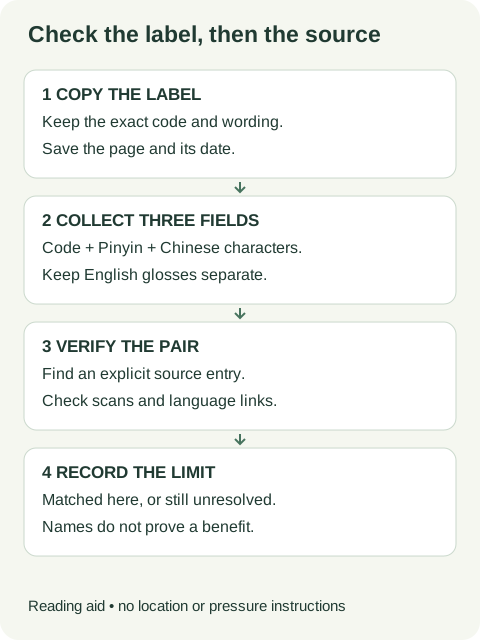
View the four-step label-check route. Keep observation, source pairing and conclusion in order. This original diagram is a reading aid, not an anatomical map.
Download the editable acupoint name-check record. It includes fourteen reference prefixes, six selected entries with locators, comparison fields and practice answers. Save it in a plain-text editor so accented letters and Chinese characters remain visible.
SOURCE A: title, edition/date, URL, page/heading
ORIGINAL LABEL: code | Pinyin | Chinese | English wording
SOURCE B: title, edition/date, URL, page/heading
ORIGINAL LABEL: code | Pinyin | Chinese | English wording
PAIRING EVIDENCE: explicit entry or linked-language heading
STATUS: matched in these sources / unresolved
OPEN QUESTION: exact missing or conflicting field
LIMIT: identity only; no location, benefit or personal clearance
Before reusing the result, confirm that a reader can reproduce it from the cited entry. Put original strings near the conclusion, distinguish copied fields from your notes and avoid extending one verified alias to a whole system. For benefit claims, begin a separate study-reading check; for an individual care question, use the clinician preparation checklist.
Six label-check cases with explanations
These original cases test the boundary between a documented name match and an unsupported assumption. Write the source or missing field first, then open the explanation. None asks you to find or press an anatomical point.
Case 1
The 1991 report lists PC6 / nèiguān / 內關. MSK’s English page says P-6 (Neiguan), and its linked Chinese page says P-6(内关). Can these particular records be paired?
Show answer and explanation for case 1
Yes, with the named sources and original labels retained.
The report’s PC6 entry and the hospital’s paired-language headings identify Neiguan. Record PC6 and P-6 separately, along with 內關 and 内关. This example does not establish that every shortened P code on another website follows the same convention.
Case 2
An unattributed image says only “point 6.” Can you turn that into PC6?
Show answer and explanation for case 2
No. The number is not a complete identity.
Ask for the prefix, point name and source. A sixth point in another series is not established as Neiguan by the shared number. Leave the comparison unresolved rather than choosing the first search result.
Case 3
A translated caption uses a memorable English phrase but gives no code, Chinese name or reference. Is its meaning enough to identify a point?
Show answer and explanation for case 3
No. An English rendering is a clue to investigate, not an identity match.
Obtain the source’s own code and name fields. The selected report discusses English names of meridians alongside point codes, Pinyin and Han characters. Its selected tables do not give an official English title for every point.
Case 4
Text copied from a scan produces “L111,” while the original table visibly reads LI11. Should the copied text replace the source label?
Show answer and explanation for case 4
No. Check the rendered table and preserve the confirmed LI11 label.
An uppercase I and digit 1 can be confused during extraction. This discrepancy occurs in the selected report’s large-intestine table. Record the correction and page locator instead of silently using a garbled identifier.
Case 5
A label is EX-HN3 rather than one of the fourteen main-meridian prefixes. Does that prove the label is invented?
Show answer and explanation for case 5
No. The report also proposes a separate extra-point code system.
Section 3.5 describes EX plus a region abbreviation; its extra-point table lists EX-HN3 / yìntáng / 印堂. Keep that classification visible. Do not force it into the 361 classical-point list or confuse extra points with the eight extra meridians.
Case 6
A product correctly prints PC6 and says that a WHO name proves its pressure device treats a condition. Does the matching name establish that claim?
Show answer and explanation for case 6
No. Identification and effectiveness require different evidence.
A nomenclature record identifies a label. It does not test that product, establish a manual-pressure benefit or determine suitability for an individual. Save the exact product claim for a separate evidence check; a code match is not permission to use it.
Finish with a narrow conclusion that can be checked
A useful conclusion states its scope: “The selected 1991 report identifies PC6 as nèiguān / 內關; MSK’s paired-language pages call Neiguan P-6 / 内关.” A reader can see which records were compared and which variants were preserved. That is more reproducible than saying every translation is correct or every source uses one universal label.
If evidence is incomplete, retain an unresolved record with one next question: edition, prefix, characters, translation attribution or damaged scan. For a national-standard claim, obtain that standard’s relevant entry rather than borrowing this report’s authority. For a product claim, request the actual product and study evidence instead of repeating a standardized name as proof.
Keep identification, interpretation and intervention separate in your notes. Naming sources support the first task. They do not determine the clinical meaning of a sensation, establish a pressure benefit or clear an individual to act. A short traceable match with a visible limit is a useful research result.
Sources and further reading
- WHO Scientific Group: A proposed standard international acupuncture nomenclature (1991)Scientific-group report: code, Pinyin and Han-character naming elements; all fourteen meridian prefixes and selected point-name entries. Selected report pages, not an entire current nomenclature survey, clinical endorsement or WHO policy statement.
- Memorial Sloan Kettering: Acupressure for Nausea and Vomiting — EnglishPatient-education heading explicitly pairs P-6 with Neiguan; updated 2 September 2026. Used for a documented label variant, without adopting its locating or pressure instructions or assessing efficacy.
- Memorial Sloan Kettering: the linked Simplified Chinese translationThe page’s language link and heading pair P-6 with 内关. An actual paired-language example, not an independent effectiveness study or clinical review of this guide.