Practical guide
Sham Controls in Acupressure Studies: A Plain-Language Guide
A sham control is a comparison procedure designed to resemble aspects of an intervention while changing selected components. In acupressure research, the label alone does not tell you what changed. Read the actual procedures, contact and masking, then interpret the direct comparison between groups. A sham group can still receive touch, practice or attention.
What does sham acupressure mean?
“Sham” describes a comparison used in a study. It does not automatically mean no touch, no sensation or no possible effect. Researchers may change the pressure location, use a lighter touch, alter a device or choose points considered irrelevant to the condition being studied.
The purpose is to make the comparison useful for a particular research question. A procedure that resembles the tested intervention may help keep participants uncertain about which group they joined. Matching instructions and contact may also reduce differences unrelated to the component the researchers want to investigate.
However, resemblance and inactivity are separate questions. A convincing comparison can retain touch, time spent practicing and interactions with study staff. A procedure with almost no sensation may be easier to distinguish from the tested intervention. Read what was done before deciding what the comparison can explain.
This guide covers reading manual-acupressure studies and a review that also included pressure devices. It gives no point locations or treatment schedules. Findings about manual pressure should not be treated as findings about needle acupuncture, electrical stimulation or every condition for which pressure is promoted.
Sham, usual care and an active comparator answer different questions
| Comparator | What to look for | What the contrast may address |
|---|---|---|
| Sham procedure | Changed location, pressure or device; retained instructions, practice and contact. | A difference between the specific procedures implemented, subject to masking and other limits. |
| Usual care | Which ordinary care continues and whether extra contact or practice is added. | The effect of adding the intervention package to that care. |
| Active comparator | A different actual intervention, its dose, support and adherence. | How the tested packages compare under the study conditions. |
These are useful reading distinctions, not guarantees that a particular trial was designed well. “Usual care” is not necessarily the same across hospitals, countries or studies. It can include an education booklet or other support. An active comparator is not automatically an established or effective treatment merely because it is active.
If pressure plus coaching is compared with usual care without coaching, any difference belongs to the added package as studied. It does not identify pressure alone as the cause. If selected-point pressure is compared with a sham that also changes intensity, the contrast does not isolate point location alone.
The same label can cover quite different procedures
A 2015 systematic review and critique identified six categories of sham acupressure in 66 included trials involving 7,265 participants. The categories combined three location choices with manual procedures or devices: non-acupoints, the same acupoints with light touch or a modified device, and points regarded as non-therapeutic for the studied condition.
This is a historical methods review: its search ended on July 3, 2014. It is useful for understanding design variety, not a current summary of all effectiveness evidence. It excluded auricular therapies, electrical acupoint stimulation and manual, electrical or laser needle acupuncture.
The review found variation and incomplete descriptions of intensity and location. Its heterogeneous studies did not support a solid conclusion that one sham category produced a particular treatment outcome. The authors also reported that none of the included trials tested the credibility of blinding during the study period. That finding applies to the included historical sample, not automatically to every later study.
Do not use the review's six categories as a quality score or a guide to performing a sham procedure. A category tells you which aspects to inspect. The actual protocol and research question determine whether the comparison is informative.
Map the comparison before reading the headline result
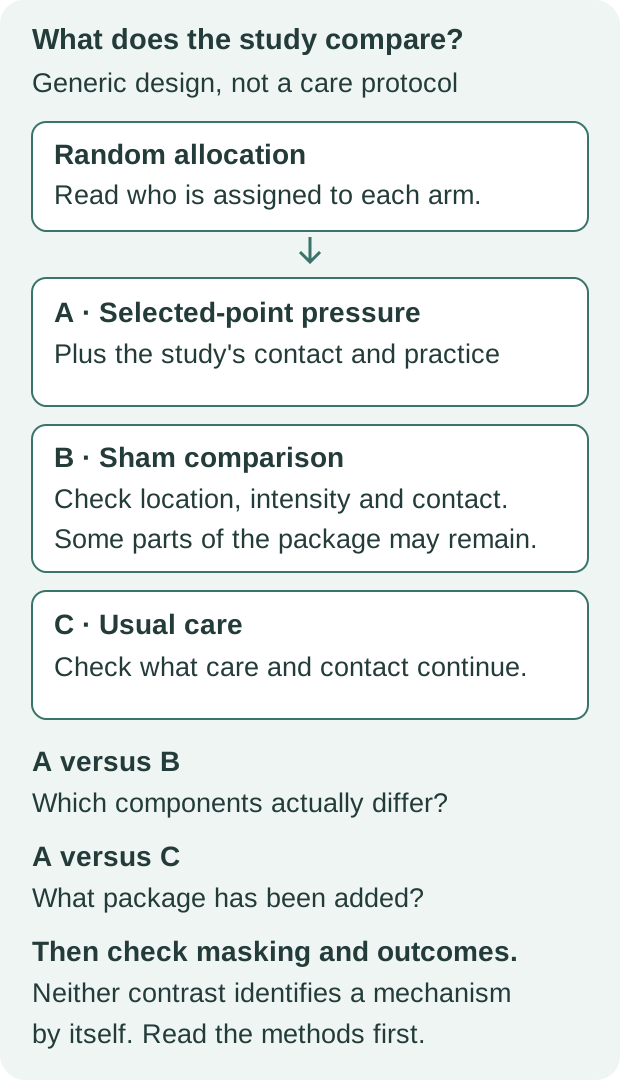
Download the study-comparison map. A two-arm study will have only the relevant two groups; the diagram does not imply that every trial needs a usual-care arm.
Write one sentence for each contrast: “Group A received ___, while group B received ___.” Then underline every difference. If the blanks remain vague, the headline does not supply the missing methods.
Check more than the names of the points
| Component | Question to ask | Why it matters |
|---|---|---|
| Location and pressure | Are location and intensity both different, or only one? | A contrast changing two components cannot identify one alone. |
| Device and sensations | Do appearance and felt stimulation differ? | Participants may recognize the procedure they received. |
| Practice and instructions | Are the instructions, schedule and opportunities to practice similar? | The routines can differ alongside the pressure procedure. |
| Contact and other care | Do groups receive similar reminders, visits and continuing care? | Extra support can be part of the tested package. |
| Adherence and follow-up | What did participants actually complete, and who is missing? | The intended protocol and observed participation may differ. |
“Not reported” is a legitimate reading note. Do not replace it with “same in both groups” or “no effect.” A referenced protocol may add details, but check that it belongs to the same trial and distinguish the planned procedure from the procedure reported in the final paper.
Touch, expectations, attention and symptom monitoring are possible contributors to responses. Similar improvement does not establish which contributor caused it. The comparator is a tool for reducing or understanding alternative explanations; it is not a measurement of every mechanism.
Random allocation, allocation concealment and blinding differ
Random allocation concerns how participants are assigned to groups. Look for the method rather than relying only on “randomized” in the title. Randomization aims to make the groups comparable at the start, but small samples can still differ by chance.
Allocation concealment concerns whether the upcoming assignment can be known before a participant is enrolled and assigned. If someone can predict the next group, enrollment decisions could influence who enters it. This is a different question from whether participants know their group after assignment.
Blinding or masking concerns who knows which procedure someone received. Name the people: participants, people delivering care, outcome assessors and analysts. A report's “single-blind” or “double-blind” label is less useful than a clear description of those roles.
Someone delivering different manual procedures may know which one they are teaching. An independent analyst can remain masked even if the provider cannot. Neither arrangement automatically establishes participant masking.
Self-reported fatigue, pain or sleep outcomes also require care: the participant supplies the rating. A separate masked assessor does not erase the participant's knowledge of their own assignment. This does not make the outcome worthless, but it limits what a blanket claim of “blinded assessment” tells you.
Was masking credible, and was it checked?
Look for how the researchers explained the procedures, whether they appeared or felt distinguishable, and whether participants had prior experience. A statement that both procedures were presented as possible interventions describes an attempt at masking; it does not itself demonstrate success.
A paper may ask participants which group they think they received or assess how credible they found the procedure. Read when the question was asked and how the answers were interpreted. A guess after improvement can reflect that improvement, so a simple guess percentage is not a complete explanation of bias.
If no assessment is reported in the material you checked, say that the success of masking is unclear from that material. Do not assert that participants were deceived, that masking certainly failed or that the study had perfect blinding. These are stronger claims than the available description supports.
Real example 1: a small self-acupressure pilot
A 2026 pilot paper studied feasibility, acceptability and preliminary fatigue outcomes in adolescent and young adult cancer survivors after treatment. Forty-two participants were allocated: 30 to relaxing acupressure and 12 to sham. The planned allocation ratio was 2:1, but the actual counts should be taken from the report rather than assumed to be 28 and 14.
Both groups used the same app-based delivery approach and received instructions and study contact. The sham used non-acupoint locations in the same body quadrants as the selected-pressure procedure. Thus “sham” did not mean that participants received no practice or no attention.
The paper reported fatigue reductions in both groups and no statistically significant between-group difference at the reported six- and ten-week comparisons. The study was a modest pilot with variable adherence, not a large definitive test of equivalence.
A defensible reading is narrow: this pilot did not demonstrate a statistically significant fatigue advantage for the relaxing procedure over its sham comparison at those times. It cannot establish that specified points are uniquely effective, that all pressure procedures are equivalent or that a person with a different condition should try the protocol.
The paper identifies trial registration NCT06442891. For the separate task of checking a registry's status and whether results are posted, use the registered-trial reading guide. Registration status and a published clinical outcome answer different questions.
Real example 2: a partially blinded three-arm trial
A 2026 three-arm trial allocated 108 breast cancer survivors after chemotherapy to selected acupressure, sham acupressure or usual care, with 36 in each arm. The two pressure groups received training and support including reminders and follow-up. The sham procedure was described as light pressure at non-acupoints; usual care included an educational booklet.
This description prompts two reading questions. First, exactly how were the selected and sham pressure procedures matched or different? Do not assume the contrast isolates location simply because the groups are named “true” and “sham.” Second, how much extra practice and contact did each pressure package add to usual care?
The methods call the study partially blinded. Participants in the two pressure groups did not know which procedure was designated true or sham, but usual-care participants could not be blinded to their allocation. Outcomes were self-rated, and the independent statistician was masked.
That combination is more informative than a single “blinded trial” label. It explains which comparison and which stages retained knowledge of allocation. This example illustrates design, not a new calculation of the trial's effects or an endorsement of treatment. Effect claims require the actual outcome, time point, analysis and uncertainty, rather than treating every reported measure as interchangeable.
Interpret the difference between groups, not just change within them
A before-and-after improvement inside one group is not the same as evidence that it did better than another group. Symptoms may fluctuate, other care may continue, participation may change daily routines, and measurements contain uncertainty. A study's between-group comparison is central to a claim that one implemented procedure outperformed its comparator.
Also distinguish “did not find a statistically significant difference” from “proved no difference.” An imprecise estimate may be compatible with several possibilities. An equivalence or non-inferiority study needs its own design and a prespecified acceptable difference; a nonsignificant superiority test does not create that design afterward.
Even a clear group difference does not identify a biological mechanism by itself. If several components changed, the result belongs to that contrast. If the outcome is self-reported and one group knows its assignment, that knowledge remains part of the interpretation.
Finish with the population, comparator, outcome and time: “In this population, procedure A was compared with B for outcome C at time D, with these limitations.” That sentence is usually more useful than “acupressure works” or “sham proves it is all placebo.”
Download a checklist for the next paper you read
Download the editable sham-control reading checklist. It has space for allocation, actual procedures, contact, masking, outcomes and the narrowest conclusion you can support. The worksheet is original and has no validated rating score.
Selected-pressure group received: __________________
Sham group actually received: _____________________
Components that differed: _________________________
Who knew the allocation: __________________________
Outcome and measurement time: _____________________
Direct comparison and uncertainty: ________________
The conclusion I can support: _____________________
Use the list to frame questions for a qualified clinician or to read a paper more carefully. It does not tell you to stop treatment, replace usual care or press a particular point. Individual health decisions require context that a general study-reading guide cannot supply.
Five design checks with explained answers
These original exercises test research-reading distinctions. They are not clinical case advice or a validated assessment.
Case 1
A paper calls its control "sham" but does not describe the pressure, location or device. Can you assume the control was inert?
Show answer and explanation for case 1
No. Record the missing details instead of inventing them.
The label does not establish what participants received or whether touch, practice or contact remained. Missing reporting limits interpretation.
Case 2
The selected-pressure group and sham group both report less fatigue. Is that enough to say the selected points worked better?
Show answer and explanation for case 2
No. Look for the direct comparison between groups.
Changes within each group can have several explanations. The reported between-group analysis is needed for a claim of superiority, along with its uncertainty and limitations.
Case 3
A small pilot reports no statistically significant difference. Can you write "the treatments are equivalent"?
Show answer and explanation for case 3
No. A nonsignificant result is not an equivalence demonstration.
Equivalence requires an appropriate design and a prespecified acceptable difference, not simply a conventional significance test that did not cross its threshold. A small study may also be imprecise.
Case 4
A trial masks its statistician, but participants know they received only usual care and rate their own symptoms. Is every stage blinded?
Show answer and explanation for case 4
No. Identify the people and outcomes separately.
Analyst masking does not hide allocation from participants. Participant knowledge matters when interpreting self-reported outcomes, even if the analysis is masked.
Case 5
Selected pressure differs from sham in both location and intensity. Does a group difference identify the location alone as its cause?
Show answer and explanation for case 5
No. More than one component changed.
The contrast tests the procedures as implemented. It cannot cleanly attribute any difference to location alone when pressure intensity also differs.
Sources and further reading
- Tan and colleagues (2015): Sham Acupressure Controls Used in Randomized Controlled Trials: A Systematic Review and CritiqueHistorical six-category comparator inventory and reporting/blinding limitations; search through July 3, 2014. Not a current effectiveness synthesis.
- 2026 pilot report of app-delivered self-acupressure in adolescent and young adult cancer survivors (PMC13290998)Actual 42-participant allocation of 30/12, matched delivery and contact, non-acupoint sham, pilot aims and nonsignificant between-group fatigue comparisons.
- 2026 three-arm acupressure trial in breast cancer survivors after chemotherapy (PMC13582098)Actual 108-participant allocation, light-pressure non-acupoint sham, usual-care education, partial participant masking, self-rated outcomes and masked statistician. Used as a design example.