printable
Acupoint Session Observation Log Worksheet | Facts, Stops, and Questions
Record observable facts and unanswered questions from an acupoint reading or low-risk touch event without turning the record into a condition conclusion, personal care plan, or safety clearance.
Quick Answer
Use one row for one event: source, point label, broad body area, whether touch occurred, immediately observable facts, stop reason, and the next question. Do not score symptom improvement or infer that a point changed a health condition.
Before You Try This
This log is informational, is not medical advice, and does not identify a condition, claim a health outcome, recommend points, choose pressure, set duration or frequency, or provide emergency guidance. Do not use it to continue through pain, skin changes, numbness, dizziness, worsening symptoms, or uncertainty.
Ask qualified care about pregnancy, medication, bleeding risk, chronic illness, injury, skin conditions, persistent or severe symptoms, technique questions, or any concern that needs personal assessment. Use urgent services for urgent symptoms.
Acupoint Session Observation Log
Record what source you read, what body area was discussed, whether touch occurred, what was immediately observable, why you stopped, and what you need to ask. Leave condition conclusions and outcome judgments blank.
Information checked: 2026-07-12| Log field | Record | Do not convert it into | Stop or next step |
|---|---|---|---|
| Source and point label | Page title, URL, point code, and date read. | Proof that the page applies to you. | Return to the full source and safety boundary before any later use. |
| Body area and landmark words | The broad region and exact words used by the source. | A self-confirmed clinical point location. | Stay read-only when the landmark or side is unclear. |
| Touch status | No touch, light contact, or stopped before contact. | A recommended pressure level, duration, or frequency. | Do not add needling, deep pressure, or improvised technique. |
| Immediately observable facts | Skin appearance, comfort, irritation, tenderness, dizziness, or another plain observation without interpretation. | A condition conclusion, health-response rating, or claim that a point worked. | Stop for pain, worsening discomfort, skin change, numbness, faintness, or unusual symptoms. |
| Context to disclose | Pregnancy, medication, bleeding risk, chronic illness, recent injury, skin condition, or ongoing care, if relevant to a professional conversation. | Personal clearance from a public template. | Ask the qualified professional who manages the relevant condition or medicine. |
| Questions for follow-up | What remains unclear about scope, location language, safety, evidence, or coordination with care. | A substitute for clinical assessment or emergency help. | Bring the question list to qualified care; use urgent services for urgent concerns. |
- What condition or symptom you have.
- Whether an acupoint activity changed a health outcome.
- Which point, pressure, duration, or frequency to use.
- Whether pregnancy, medication, injury, chronic illness, or urgent symptoms make an activity safe.
Is This the Right Page to Read Now?
Use Acupoint Session Observation Log Worksheet | Facts, Stops, and Questions as a compact memory card only after the full page task is clear for : Record observable facts and unanswered questions from an acupoint reading or low-risk touch event without turning the record into a condition conclusion, personal care plan, or safety clearance.
Acupoint Session Observation Log Worksheet | Facts, Stops, and Questions fails if the point card becomes a standalone pressure instruction separated from the complete point and safety pages.
Keep the log with the source page, then use the unresolved-question field when speaking with a qualified professional. Keep the point card only as a reminder, not as permission to press.
Printable worksheet
Observation log
Use one row for one reading or touch event. Record only what you read or immediately observed, then stop at uncertainty.
| Source and date | Point or page | Broad body area | Touch status | Observable facts or stop reason | Question for qualified care |
|---|---|---|---|---|---|
Keep the log within these boundaries
- Do not name a condition or rate a health outcome.
- Do not add a pressure amount, duration, repetition, or frequency.
- Use urgent services for severe, sudden, worsening, or alarming symptoms.
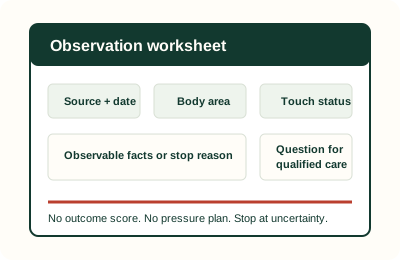
Acupoint Session Observation Log worksheet visual check
- Keep source, date, point or page, broad body area, touch status, observations, and the next question in separate fields.
- Leave pressure amounts, schedules, condition conclusions, and outcome scores outside the worksheet.
- Use a stop reason or an unanswered question as a complete record rather than filling every field.
Acupoint Session Observation Log is a factual observation aid, not a condition assessment, outcome tracker, or personal care plan.
Why This Page Gets Extra Attention
Reader Scenario
A reader needs Acupoint Session Observation Log to choose one next page, not to collect a larger set of options.
Common Misread
Do not treat Acupoint Session Observation Log as permission to browse past the page's own boundary.
Editorial Call
Acupoint Session Observation Log should make one conservative printable decision easier and name the reason for the next click.
Best Next Choice
Choose one printable next page for Acupoint Session Observation Log, then reassess before continuing.
Use the visual as a reading route, not a private safety clearance.
Record the source before the body note
Write the page title, URL, point code, and date first. This keeps the observation tied to the exact information you read and makes later questions easier to check.
Use plain observations instead of interpretation
Record visible skin condition, comfort, irritation, tenderness, dizziness, or why you stopped in ordinary language. Do not write that the point caused a condition, corrected an imbalance, changed a health outcome, or explains a symptom.
Leave pressure plans out
The log has no recommended pressure, duration, repetition, or frequency. If a source or professional gives instructions, record where they came from and ask how they apply to your situation rather than inventing a schedule.
Make stopping a completed action
Stopping before touch, after uncertainty, or when discomfort appears is useful information. A blank activity field is not a failed session; it can show that the safety boundary worked.
Prepare the next professional question
Use the last field to ask about credentials, scope, location uncertainty, expected sensations, medication, pregnancy, injury, skin condition, evidence limits, or coordination with other care.
Keep urgent concerns out of the worksheet
A log is not an emergency tool. Severe, sudden, worsening, or alarming symptoms need appropriate urgent evaluation rather than more point comparison or a more detailed record.
Questions Readers Usually Ask
Can I use the point card without the full page?
No. Treat the card as a memory aid after the full point page has explained location, pressure limits, stop signs, and when to stay reading-only.
What should I check before saving the point card?
This log is informational, is not medical advice, and does not identify a condition, claim a health outcome, recommend points, choose pressure, set duration or frequency, or provide emergency guidance. Do not use it to continue through pain, skin changes, numbness, dizziness, worsening symptoms, or uncertainty. Save the card only when the use case remains mild, low-risk, and easy to stop without escalating pressure.
Where is the full point page for this card?
Keep the log with the source page, then use the unresolved-question field when speaking with a qualified professional. Use the full page to confirm location and safety before treating a card as a memory aid.
Where should I go next from Acupoint Session Observation Log?
Use Acupoint Session Observation Log to choose one next step. If the safety boundary does not fit, stop browsing point pages and use a safety or care path instead.
Sources Used
For Acupoint Session Observation Log Worksheet | Facts, Stops, and Questions, these notes are tied to this page asset: A printable six-field observation table that separates factual memory from condition conclusions, outcome ratings, amount or schedule decisions, and personal safety decisions. They show which references support names, location terms, safety boundaries, cultural context, visual attribution, or content-check wording. They do not assess your symptoms, medication, pregnancy status, skin, or personal health situation for this page.